
Randolph County Projected Release Dates
A projected date is a calculation or planned event. It is not the jail’s actual release timestamp. Missouri’s historical DOC field layout uses two specific sentence markers: “Sentence-I Minimum Release Date” and “Sentence Maximum Release Date.” A presumptive parole date or conditional-release date is another kind of marker. Each has a separate role.
An actual release needs an administrative event showing that a custodian relinquished control. Even a location-end date at Moberly Correctional Center may mean transfer to another prison. Read the next assigned place, supervision status, completed flag, and other sentence rows before describing a community exit.
Scheduled vs actual: A calculated or Board-related date may move. The controlling DOC or jail record establishes what ultimately occurred.
- Minimum release date
- A DOC-calculated minimum marker on an active sentence, not guaranteed parole.
- Maximum release date
- The maximum release or expiration marker for that sentence row.
- Conditional release
- A statutory portion of a prison sentence served in the community under conditions.
- Actual release
- The recorded event when the named custodian ends physical control, which can include a transfer.
Find Randolph County Projected Release Dates
Start with the facility. The Randolph County Jail holds pretrial detainees and eligible local-sentence prisoners. Moberly Correctional Center is a Missouri state prison. The same search method cannot answer both cases.
- Identify whether the person is in the county jail, MCC, another Missouri prison, or a different system.
- For a state prisoner, use the Missouri DOC active offender search to confirm the DOC number and assigned place.
- Consult the DOC Sunshine field layout and nightly data for minimum and maximum sentence-date fields.
- Match the court cause number and read the judgment, sentence length, and concurrent or consecutive structure in Case.net.
- Check whether a statutory minimum, parole action, or conditional-release process affects the calculation.
- For the Randolph County Jail, ask the sheriff and court how the specific local term and credit were computed.
- Confirm an actual exit with DOC location/status history or the county jail release transaction.
The public DOC name search should not be promised to display a projected date unless the field appears in the live result. It is useful for identity and active status. The historical Sunshine layout is the documented source for the sentence minimum and maximum fields.
When the person has more than one sentence, do not select the earliest date and stop. Group all rows by DOC ID, compare each cause number, and note whether the terms run together or one after another. A completed row can coexist with an active row. The date that answers “when will they get out” must account for the entire controlling sentence structure, not one convenient line.
Note: Record the DOC search freshness time because a displayed status can trail the agency’s controlling file.
Randolph County DOC Date Fields
Missouri’s nightly working file is unusually important. It covers current and former DOC supervision, with data extending as early as 1974. The file is not a certified record, and DOC cautions that it may be incomplete or inaccurate. It also uses one record per charge, so one person may have several rows.
| Field | How to read it |
|---|---|
| DOC ID | Use the permanent number to group rows and separate namesakes. |
| Assigned place and location history | Shows movement between prison and supervision settings; a location end can be a transfer. |
| Sentence-I Minimum Release Date | Calculated minimum marker on the active sentence, not a promised exit. |
| Sentence Maximum Release Date | Maximum release or expiration marker for that sentence row. |
| Completed Flag | A “Y” marks the documented sentence row complete; other active rows may remain. |
| Concurrent/consecutive indicator | Shows whether a sentence runs with another term or after it. |
| Court cause number | Connects the DOC calculation to the sentencing case. |
The official prison and conditional-release statute view below shows why a sentence date can involve both confinement and supervised release.
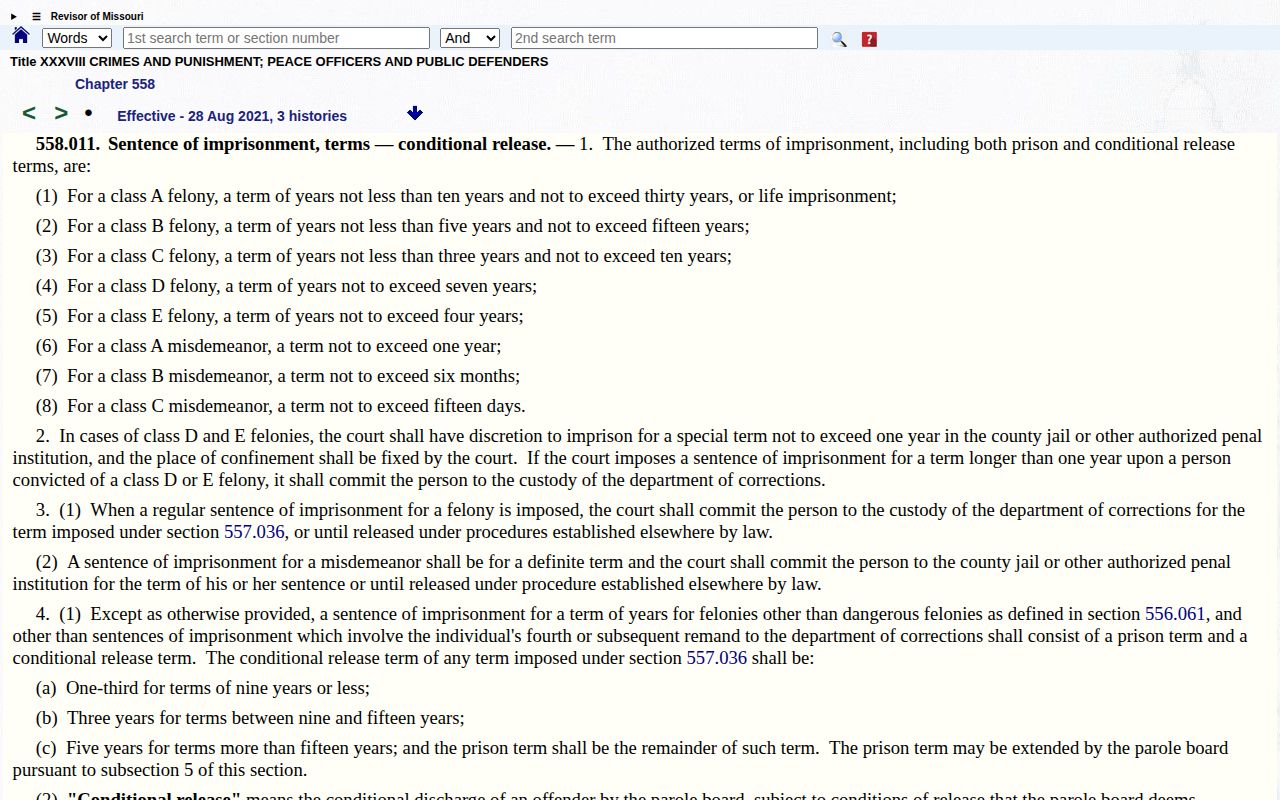
Use the DOC fields as calculation evidence, then reconcile the sentence structure with court and location records.
Randolph County Minimum Prison Terms
RSMo 558.019 is not a blanket rule that every Missouri prisoner serves 85 percent. It applies to specified offenders and dangerous felonies. Covered repeat commitments can carry thresholds of 40 percent after one prior DOC commitment, 50 percent after two, and 80 percent after three or more. A dangerous felony, as defined in the current list in RSMo 556.061, carries the statute’s 85-percent minimum or age-70 alternative.
The offense, statutory class, sentence, prior commitments, and controlling version of the law all matter. A quick percentage applied to the full term can be wrong. The court judgment and DOC calculation should be read together, especially when several sentences run concurrently or consecutively.
Minimum service and release are also separate stages. Meeting a minimum can affect eligibility for a later decision, but it does not order the gate to open. A Board action, another sentence, a detainer, or a calculation change may still control what happens next. Keep the statutory threshold in its proper place within the full record.
The official minimum-term statute view illustrates why the rule must be applied to the specific sentence.
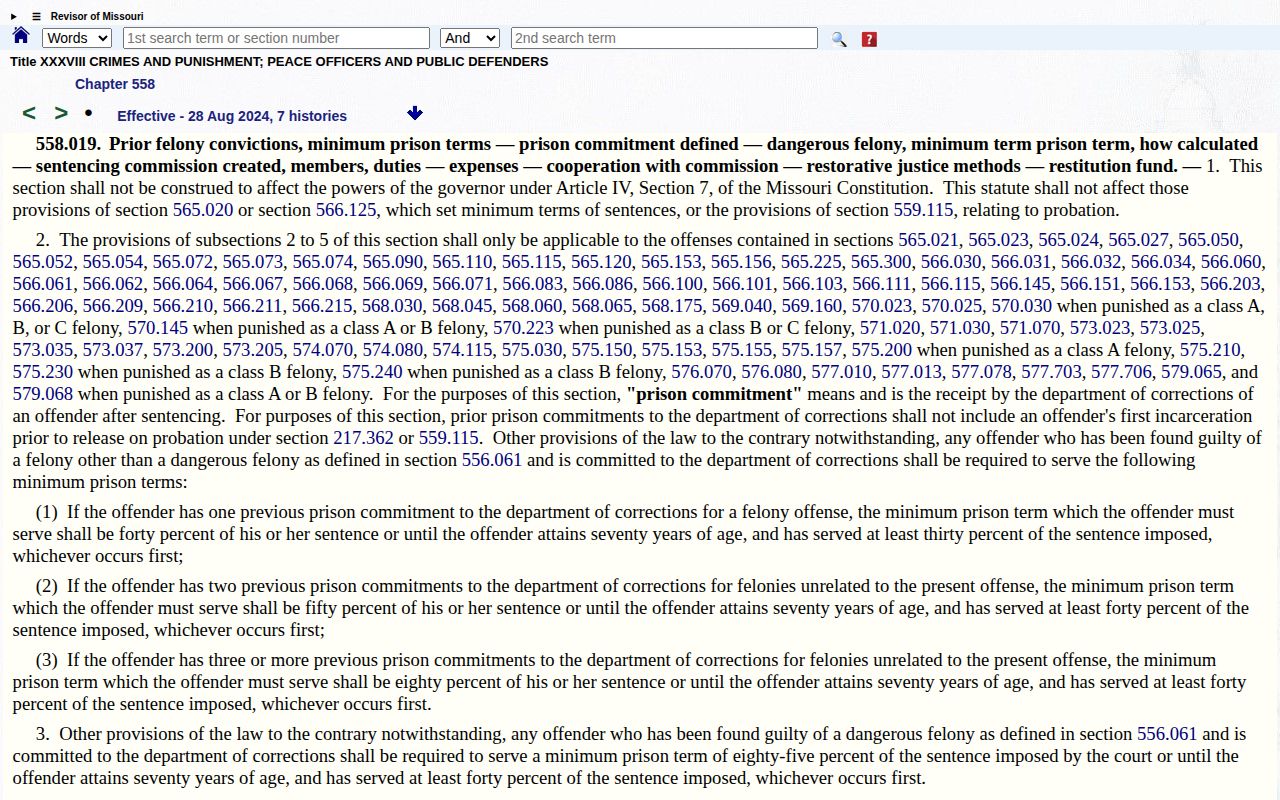
The statutory threshold affects eligibility and calculation, but it still does not establish the day a person physically leaves custody.
Note: Confirm the current statutory text and sentence facts instead of relying on a general percentage claim.
Randolph County Good-Time Effects
RSMo 558.041 permits conditional additional good-time credit for eligible DOC prisoners. It depends on the superintendent’s recommendation, peaceful and orderly service, rehabilitative participation, DOC rules, and statutory eligibility. The credit can be forfeited for violations. It is not automatic and does not guarantee release.
Conditional release is governed separately by RSMo 558.011. A prison term may be followed by a supervised conditional-release portion. After the required process, the Board may extend that date, potentially through the sentence. Parole is discretionary Board release, while maximum release concerns sentence expiration. These terms should not be merged.
No Randolph County jail good-time or weekend-release policy was found in the official sources reviewed. For a local sentence, use the judgment and ask the sheriff or court how that person’s time and credits were calculated. State-prison formulas should not be imported into a county-jail case.
Earned compliance credits under RSMo 217.703 are different again. They concern eligible months of compliant community supervision, not the prison term. Those credits may help explain an earlier supervision discharge after release, but they do not supply the day an MCC prisoner will first enter the community. Keeping prison good time, conditional release, and supervision credit apart prevents a false projected date.
Why Randolph County Release Dates Change
Several records can alter or clarify an estimate. The cause should be tied to the agency file rather than guessed from the passage of time.
| Cause | Possible effect |
|---|---|
| Sentence correction or appeal | Changes the legal term or credits. |
| Concurrent or consecutive terms | Changes the aggregate calculation. |
| Statutory minimum | Delays eligibility despite other credits. |
| Good-time award or forfeiture | May advance or delay an eligible calculation. |
| Board action | A grant, denial, deferment, or later change affects a discretionary path. |
| Conditional-release extension | Can delay community release after the prescribed process. |
| Detainer or another sentence | May cause a custodial transfer instead of community release. |
A parole hearing also does not supply an instant outcome. The Missouri Parole Board operates under RSMo 217.690, and DOC says a decision commonly takes eight to twelve weeks. A future release date may remain contingent on conduct, program, and release-plan matters. No public name-searchable Board results database was found.
Randolph County Active-Only Search Split
Missouri separates current status from historical research. The public name search covers active offenders, including people in prison and those on parole or probation, and expressly says it does not provide information on discharged offenders. The nightly Sunshine working file covers people currently or formerly under DOC supervision.
This split is the key distinctive fact for Randolph County state-prison release research. A person released from MCC to active parole may still be found in the public search. After full discharge, the same person can disappear from that portal by design. A no-result therefore does not erase the sentence or prove that no release occurred.
Reconcile the DOC ID, cause number, completed flag, assigned place, location dates, and all sentence rows. For a firm result, request the relevant DOC record. The nightly file is a research tool, not a certified release certificate.
Note: A completed charge row beside an active row does not mean all DOC custody or supervision has ended.
Randolph County Jail Date Limits
A pretrial detainee usually has no projected release date. The exit can depend on bond, a new court order, dismissal, plea and sentence, or another hold. The jail’s current roster is not a future-date calendar. If the name drops off, ask for the release transaction and destination because removal may represent a transfer to DOC, another county, or a federal authority.
A bond entry or signed release order can show legal authority for an exit, yet another hold may prevent the person from leaving. For that reason, the sheriff’s physical release time remains essential. If the record says “transfer,” follow the receiving authority instead of reporting that the person returned to the community.
For a sentenced local prisoner, compare the written judgment with the sheriff’s record. The court explains the legal term and any orders. The jail record gives the physical release time or receiving authority. For a complete named-person path, use the Randolph County release-record search.
Confirm Randolph County Actual Release
For MCC, confirm the actual event through DOC status and location history or a custodian-supplied record. For the county jail, request the admission and release time, recorded release type, destination, cause number, and receiving authority. A court order can explain why release was authorized but may not show when jail staff completed the exit.
Notification is useful for a pending event. MOVANS covers DOC custody, parole-hearing, and scheduled-release information for its program, while VINELink depends on the participating agency. The Randolph County VINELink check explains how to read the reporting facility and event wording. Treat an alert as notice, then verify it with the custodian.
Final check: Match the planned date to the actual location or release event and confirm whether another custodian took control.