
MCC Release and Transfer Paths
Moberly Correctional Center is a medium and minimum security state prison operated by the Missouri Department of Corrections. It is not part of the Randolph County Sheriff’s Office. A person paroled or placed on conditional release can live in the community while remaining in DOC legal custody and under field supervision. Parole is a discretionary community release under conditions. Conditional release is the statutory community portion of a sentence, also subject to conditions.
A sentence discharge is different. It means the relevant DOC sentence or supervision term has ended. The public Missouri DOC name search expressly excludes discharged offenders, so a missing result may reflect completed custody rather than the lack of a record. A move from MCC to another state institution is also distinct. That is a prison transfer, not a release to the community. Location history, assigned place, supervision status, and the completed flag must be read together.
Note: Leaving the MCC building does not by itself show freedom from DOC custody, supervision, or another prison placement.
Confirm a Moberly Center Release
Start with the official Missouri DOC Offender Web Search. The service covers active offenders, including people in prison and people on active probation, parole, or conditional release. It does not provide information on discharged offenders. Search by first and last name, then repeat with a known alias or spelling variant. Use the DOC number, date or age information, offense, assigned place, and supervision clues to distinguish a namesake.
Search the properly spelled name and aliases in the active DOC interface.
Record the result’s freshness time, DOC number, assigned place, and supervision status.
Read a prison assignment as custody and a field-supervision status as release from prison with DOC control continuing.
If a known DOC person is absent, move to the historical Sunshine file or submit a focused DOC request.
The Randolph County release search guide helps when court, notification, county, and DOC records must be reconciled. For a specific status question, DOC directs inquiries to the institutional caseworker or the probation and parole field officer. The public search is useful evidence, but it is not a certified discharge record.
MCC Records and Contact
The official institution page supplies the facility address and telephone number. Its listed open or visiting periods concern institutional access, not discharge processing, and they should not be treated as release hours. Call before travel and ask which DOC unit handles the precise record or status question.
Moberly Correctional Center
5201 South Morley
Moberly, MO 65270
660-263-3778
Review the current MCC institution page for official contact and visiting information.
For existing DOC records, use the Office of Director Sunshine custodian at OD.SunshineRequest@doc.mo.gov. Parole Board records go to ParoleBoard.SunshineRequest@doc.mo.gov. A useful request identifies the person and DOC number, then asks for release or discharge history, MCC location start and end dates, subsequent locations, sentence minimum and maximum dates, completed flags, supervision start and end status, and any releasable identification image. Medical material, records closed by law, and internal security reports can remain protected under RSMo 217.075.
MCC Historical Discharge Search
Missouri’s historical route is the DOC Sunshine Law working data. DOC says this nightly file includes people currently or formerly under supervision and reaches as early as 1974. It is especially important for MCC research because the public name locator leaves out discharged offenders. The working data can identify a DOC ID, court cause number, sentence record, completed flag, supervision data, and a trail of assigned locations.
The file is not a certified record. DOC warns that it is working data, may be incomplete, and can include self-reported information. It also uses one row per charge. Several rows can belong to the same person, and one completed row can sit beside another active sentence. Reconcile rows by DOC ID, cause number, completed flag, sentence, assigned place, and location dates before drawing a conclusion. When a formal confirmation is needed, ask the custodian for the underlying or certified record.
| DOC field | How it helps with MCC |
|---|---|
| DOC ID | Keeps records for similar names separate. |
| Assigned place and location history | Shows MCC placement, a later prison, or a community-supervision location. |
| Completed Flag | Marks a completed sentence row, but not necessarily every DOC term. |
| Sentence Maximum Release Date | Shows a sentence expiration marker, not the physical gate time. |
| Sentence-I Minimum Release Date | Shows a DOC calculation, not guaranteed parole or actual release. |
| Probation date, type, and term | Can identify field-supervision information when present. |
| Court cause number | Connects the state record with the sentencing court file. |
MCC Release Dates Need Context
Missouri DOC records contain several dates that serve different purposes. A Sentence-I Minimum Release Date is a calculated minimum marker on an active sentence. A Sentence Maximum Release Date is the sentence’s maximum release or expiration point. A presumptive parole or conditional-release date may change because it depends on legal and administrative conditions. None of these is automatically the actual day the person physically left MCC.
A location end date is closer to the institutional movement, but even that can represent a transfer. Check the next assigned location. If another prison follows, custody continued inside DOC. If a field-supervision place or parole status follows, the person left prison but remained under DOC legal custody. A completed flag can show that one sentence row ended, yet concurrent or consecutive rows may remain. The strongest conclusion comes from the full sequence, not one date field.
MCC Release Supervision in Moberly
Missouri DOC says each institution has a reentry center that helps prepare people for release. That service is part of release planning, not proof that release has occurred. Current institutional personnel should be checked through MCC because staff assignments can change. Once a person enters community supervision in the Randolph County area, the District 6S Moberly Satellite Office is the local point documented in the current DOC directory.
District 6S, Moberly Satellite Office
1317 East Highway 24, Suite B
Moberly, MO 65270
660-263-3762
Verify the current office listing before visiting or mailing.
The field office can address case-specific supervision questions when the person is assigned there. It does not replace MCC’s institutional movement record or the Parole Board’s record. A person on parole or conditional release remains subject to conditions. A person whose sentence is fully discharged follows the historical data and records-request path because the active public name search will omit that person.
MCC Release History and Identity
The DOC family page says Moberly Correctional Center was built in October 1962 and opened in January 1963. It occupies about 298 state-owned acres and includes 24 buildings. These details place MCC within Randolph County’s local history, but its records remain state correctional records. The Randolph County Jail follows a separate county legal and administrative path.
That distinction is central to a search for “Moberly release records.” Moberly may refer to MCC, the District 6S supervision office, or simply the city. The operator resolves the ambiguity. MCC releases and transfers belong to Missouri DOC. A Randolph County Jail release belongs first to the sheriff. Community supervision belongs to probation and parole. Naming the agency prevents a county roster search from being mistaken for a state-prison discharge search.
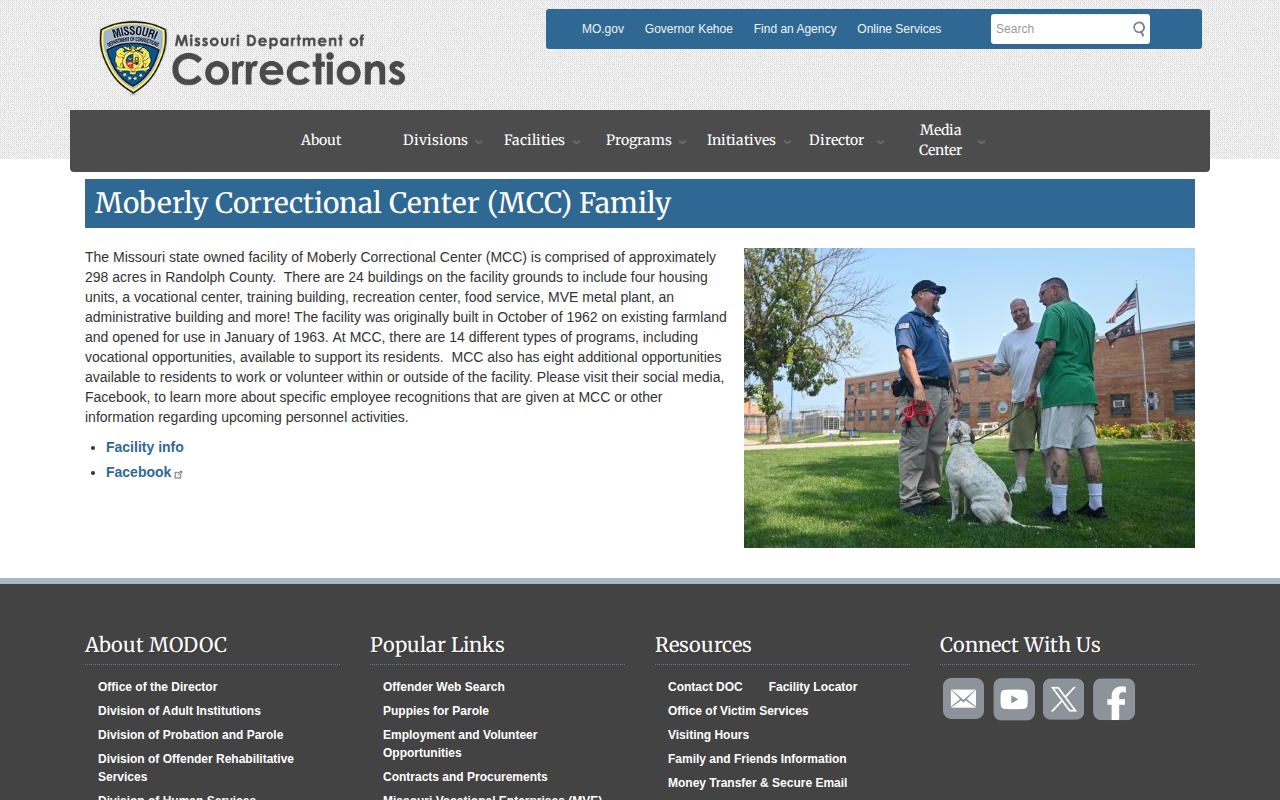
The official MCC family and history page shows the institution’s campus and historical account. The corresponding facility image reinforces that this is a DOC institution, not the county Justice Center.
Use that agency identity as the first filter before choosing a search portal or sending a record request.
MCC Statistics Are Not Releases
The 2025 PREA audit reports a rated capacity of 1,800, an audit-time population of 1,733 adult men, and 1,330 admissions during the prior twelve months. These are state-prison figures from that audit context. They do not count Randolph County jail bookings, MCC community releases, parole grants, or sentence discharges.
Admissions measure entries, not exits. Capacity describes the rated institution, not a live head count. A release inquiry still requires the person-specific active search, historical file, location trail, board or supervision record, and court cause as applicable.
MCC Release Court Record Check
A DOC cause number connects the correctional record to Missouri Case.net and the sentencing court. Court entries can show the judgment, sentence, probation, revocation, commitment, or later discharge order. They may explain the authority behind the DOC term. A docket does not always record the exact time a person left MCC, and sealed or confidential material may not appear in a public name search.
Use the court file to test the identity and legal history, then use DOC location and release records to establish the correctional movement. If a docket entry has no linked document, that can mean no public attachment or an access limit. Public courthouse terminals can offer access to public documents that are not remotely viewable, while closed records remain restricted.
About Moberly Correctional Center
MCC is a Missouri DOC medium and minimum security prison in Moberly. It holds sentenced state prisoners and uses statewide correctional systems. The county jail’s JailTracker has no role in confirming an MCC parole, conditional release, discharge, or prison transfer.
The practical record chain begins with the active DOC search, then moves to historical Sunshine data when a known person is absent. Location rows distinguish MCC departure from community release. Parole Board, field-office, and court records add the legal and supervision context. A focused DOC request can provide the formal release or discharge history when the public tools do not settle the question.